Thailand LTR Visa for Remote Workers 2026: Do You Qualify?
The Work-from-Thailand Professional category of the LTR Visa sounds like it was designed for digital nomads. It was not. It was designed for senior employees of large, well-established overseas corporations. Many remote workers read the marketing and assume they qualify. Most of them do not, and the employer revenue requirement is usually the reason.
This guide uses the official BOI criteria to tell you clearly whether you qualify, what the edge cases look like, and what your options are if you fall short.
The Quick Eligibility Test
Before anything else, answer these three questions:
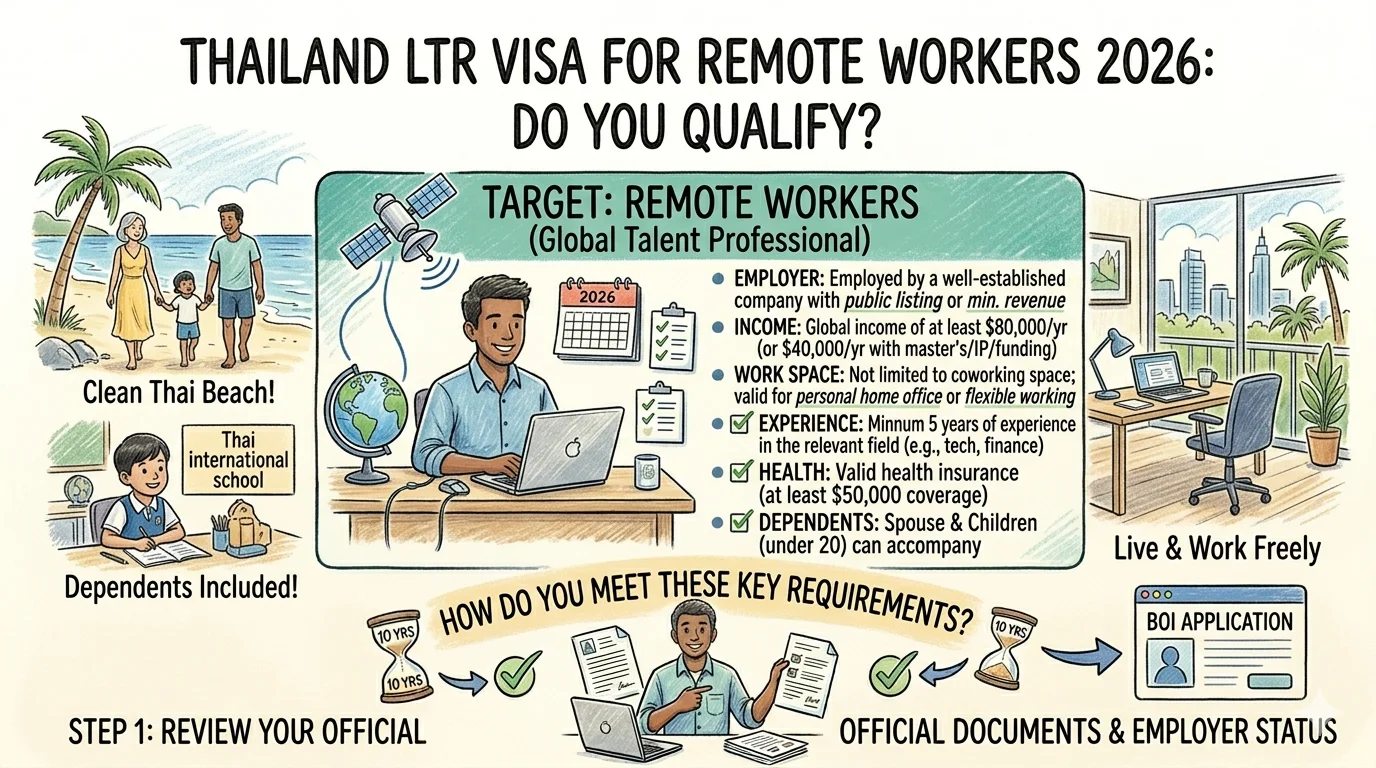
1. Did you earn at least USD 80,000 per year on average over the past two years? If no: do you earn at least USD 40,000 and hold a master's degree or higher?
2. Is your employer a public company listed on a stock exchange, a private company with at least 3 years of operation and combined revenue of USD 50 million or more over the last 3 years, or a wholly owned subsidiary of either?
3. Do you have health insurance with minimum USD 50,000 coverage, or USD 100,000 maintained in a Thai bank account for at least 12 months?
If you answered yes to all three: you likely qualify. If question two stopped you, read the employer section carefully before drawing conclusions.
The Income Requirement
Standard route: Average personal income of USD 80,000 or more per year over the past two years. The BOI uses completed tax years. Your 2026 projections and income trajectory are irrelevant. What counts is what your tax returns and payslips show for the two most recently completed years.
If your income was USD 90,000 in year one and USD 70,000 in year two, your average is USD 80,000 and you meet the threshold. If your income was USD 85,000 in year one and USD 65,000 in year two, your average is USD 75,000 and you do not, regardless of what you expect to earn in future.
Reduced income route: If your average income is between USD 40,000 and USD 80,000 per year, you can still qualify by providing proof of a master's degree or higher. The degree does not need to be in a specific field for this category, unlike the Highly Skilled Professional category which requires sciences and technology specifically.
The Employer Requirement: Where Most Applications Fail
This is the requirement that disqualifies the most remote workers. Your employer must be one of the following three structures:
Option 1: A public company listed on a recognised stock exchange anywhere in the world.
Option 2: A private company that has been in operation for at least 3 years and has a combined revenue of USD 50 million or more over the past 3 consecutive years.
Option 3: A wholly owned subsidiary of a public listed company, or a wholly owned subsidiary that holds 100 percent of the shares of a qualifying private company meeting the criteria in Option 2.
Employer Type | Qualifies? |
|---|---|
Public company listed on stock exchange | Yes |
Private company 3+ years, USD 50M+ revenue | Yes |
Wholly owned subsidiary of either above | Yes |
Private company under USD 50M revenue | No |
Startup or pre-revenue company | No |
Freelance clients (multiple) | No |
Self-employed / sole trader | No |
Your own company | No (unless it meets revenue threshold) |
Proving your employer qualifies: For publicly listed companies, the stock exchange listing is verifiable and the BOI accepts standard documentation. For private companies, you need to prove 3 years of operation and USD 50 million in combined revenue over those 3 years. This means annual reports, audited financial statements, or equivalent documentation. HR letters and verbal confirmation from your employer are not sufficient.
No Work Permit for This Category
This distinction matters and is frequently misunderstood. Work-from-Thailand Professionals are not eligible for a Thai work permit. Their employment relationship remains exclusively with the overseas employer. This means:
You cannot work for Thai companies or clients under this visa
You cannot take on Thai-based contracts or freelance work in Thailand
You can only perform work for your qualifying overseas employer
If you need to work for Thai entities or take local clients, you are not in the right category. The Highly Skilled Professional category is the one that permits working for Thai companies, but it requires employment in a BOI-targeted industry.
Dependents of Work-from-Thailand visa holders can apply for Thai work permits separately, regardless of the primary holder's restrictions.
What Freelancers and Self-Employed Workers Need to Know
The Work-from-Thailand category is structured around an employment relationship with a qualifying employer. Freelancers with multiple clients, self-employed individuals, and independent contractors without a formal employment contract with a qualifying company generally do not meet the employer requirement.
Following 2025 updates, the BOI signalled more openness to reviewing contract-based and project-based work arrangements. In practice, this flexibility has been applied unevenly and the category still functions primarily as an employment-based visa. If your income comes from multiple clients rather than a single qualifying employer, your application faces significant risk of rejection.
For most freelancers and self-employed remote workers, the DTV Visa is the more realistic path. It requires 500,000 baht (approximately USD 14,000) in savings with no employer revenue requirement and no income threshold. It is a 180-day visa with extension options rather than a 10-year residency, but for most independent workers the qualification bar is achievable where the LTR is not.
What You Get If You Qualify
The Work-from-Thailand category carries the same 10-year visa structure and core privileges as all LTR categories, plus one specific tax advantage:
Benefit | Detail |
|---|---|
Stay duration | 10 years (5 + 5 year extension) |
Reporting | Annual (not 90-day) |
Re-entry | Multiple re-entry permit included |
Airport | Fast-track at Suvarnabhumi, Don Mueang, Chiang Mai, Phuket |
Tax on foreign income | 0% on foreign-sourced income remitted to Thailand |
Work permit | Not applicable (overseas employer only) |
Digital work permit | Not required for remote work for overseas employer |
Dependents | Spouse and children under 20 eligible |
The 0% tax on foreign-sourced income is the defining financial advantage. Following Thailand's 2024 changes to how foreign income remittances are taxed, LTR holders in this category retain their exemption. This is a significant benefit for high earners working remotely in Thailand over a long period.
Required Documents
The BOI publishes the official document checklist for this category. Download it directly before assembling your application:
Official document list: Required Documents for Work-from-Thailand Professionals
Documents typically required include:
Valid passport (18+ months remaining)
Passport-sized photographs
Employment contract with the qualifying company
Income evidence for the past two years (payslips, tax returns, or equivalent)
Company evidence proving employer eligibility (annual reports, audited financials, stock exchange listing confirmation)
Health insurance certificate showing minimum USD 50,000 coverage, or bank statements showing USD 100,000 maintained for 12 consecutive months
Master's degree certificate (if applying under the reduced income route)
Criminal record certificate from your home country
All documents not in English or Thai must be officially translated. Documents requiring authentication must be apostilled before submission.
The Application Process
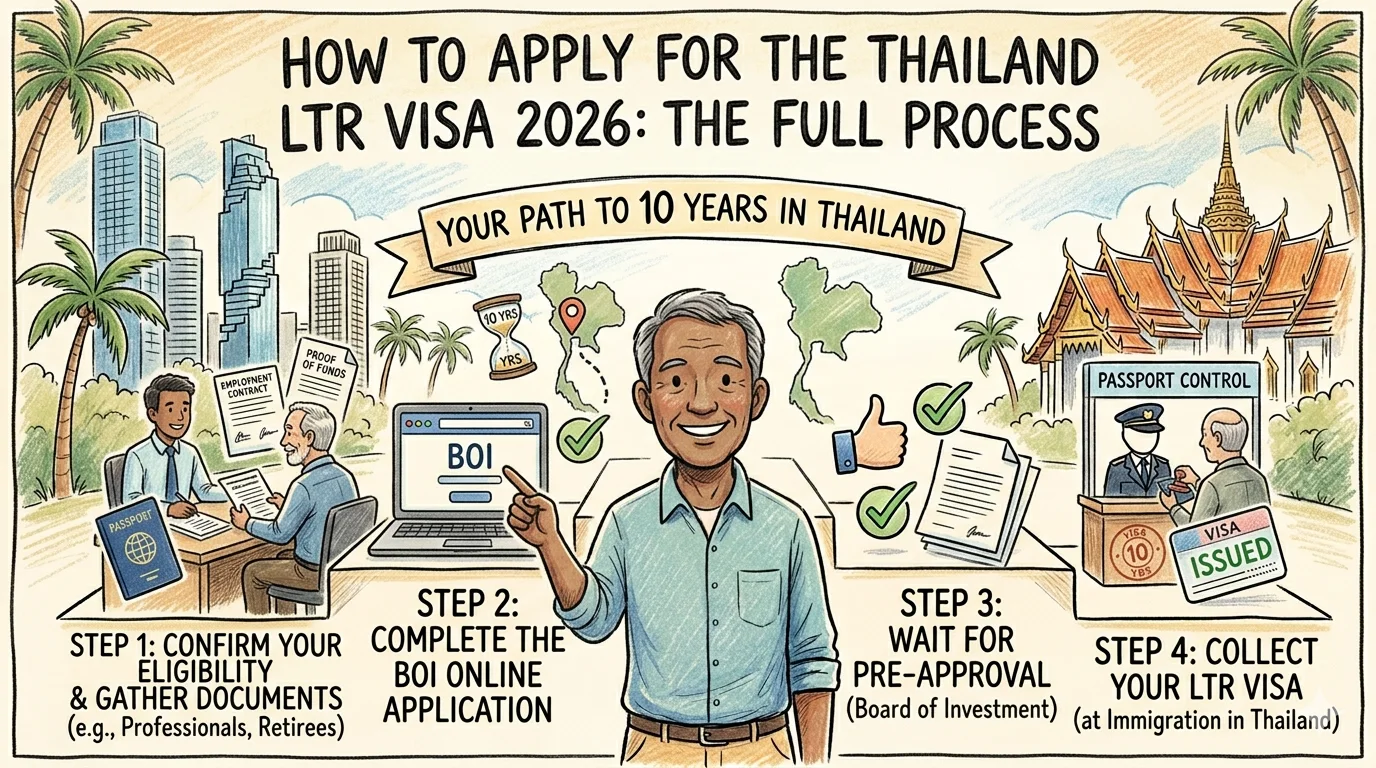
The Work-from-Thailand Professional application follows the same two-stage BOI process as all LTR categories.
Stage 1: Submit your application and documents through the BOI online portal. The BOI reviews your application and issues an endorsement within approximately 20 working days, though the full process typically takes 4 to 6 weeks.
Stage 2: Collect your visa stamp at the Thailand Investment and Expat Services Center (TIESC) in Bangkok or at a Royal Thai Embassy abroad within 60 days of your endorsement.
The government fee is 50,000 baht per person, approximately USD 1,500.
Apply here: visa.boi.go.th/register
Full application process: ltr.boi.go.th
Required documents: ltr.boi.go.th/page/required-documents.html
For the complete step-by-step application walkthrough, see How to Apply for the Thailand LTR Visa 2026.
Common Situations and Whether They Qualify
You work for a multinational listed on the NYSE, LSE, or similar exchange earning USD 95,000 per year: You qualify. Listed company, income above threshold.
You work for a 10-year-old private SaaS company earning USD 80,000 per year but cannot confirm the company's revenue: You need to obtain company financials showing USD 50 million in combined revenue over the past 3 years. Without this, the application cannot proceed regardless of your income.
You earn USD 60,000 working remotely for a qualifying company and hold a master's degree: You qualify under the reduced income route.
You freelance for five clients earning USD 120,000 per year: You do not qualify under this category. No single qualifying employer. Consider the DTV Visa.
You are a founder of a 4-year-old company generating USD 60 million in annual revenue and pay yourself USD 90,000 per year: The employer requirement focuses on the company, not you personally. If the company meets the 3-year operation and USD 50 million revenue criteria and you have a formal employment contract with it, you may qualify. Document the relationship carefully.
You earn USD 45,000 and have a master's degree working for a qualifying employer: You qualify under the reduced income route.
Your employer is a startup that raised USD 2 million Series A but has been operating for only 18 months: You do not qualify. The 3-year operation requirement is firm.
If You Do Not Qualify for This Category
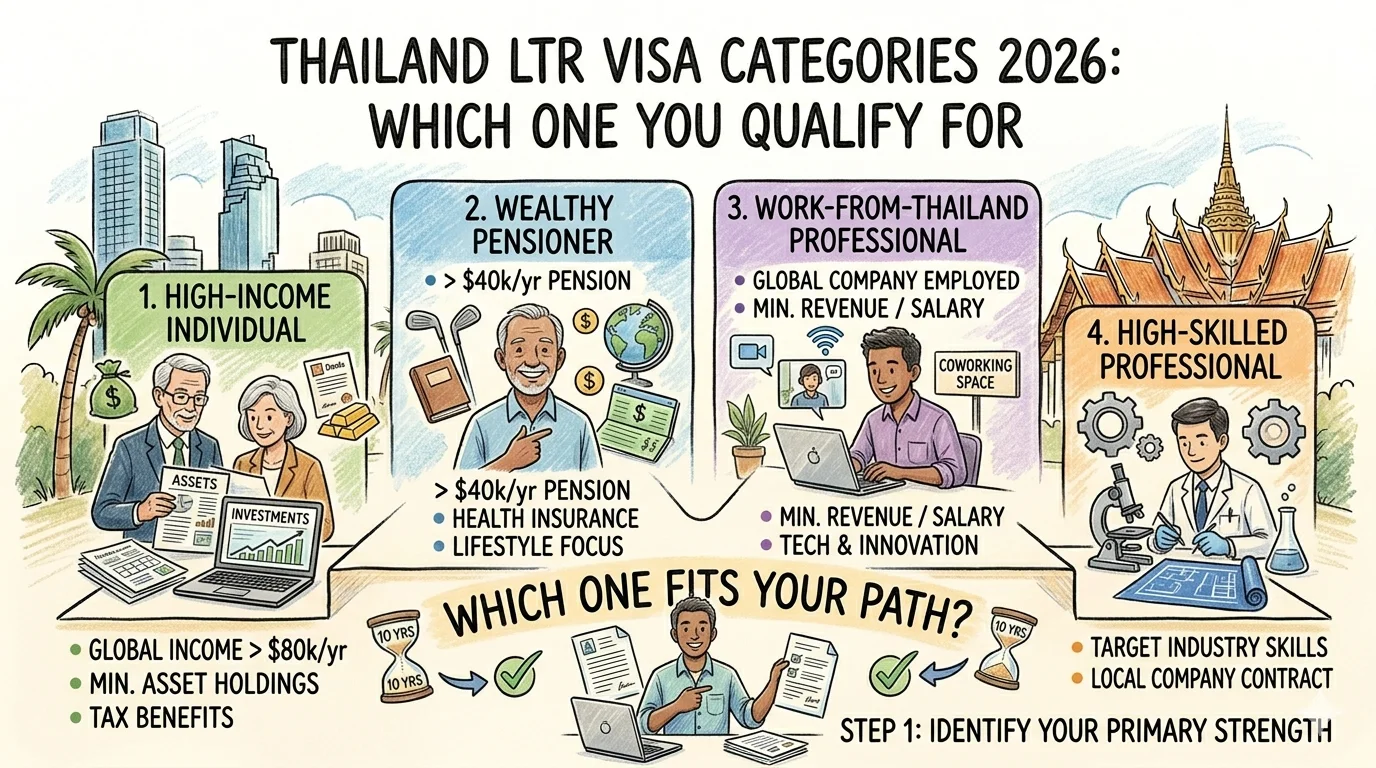
The other three LTR categories may still be an option depending on your financial situation. If you have significant assets rather than employment income, the Wealthy Global Citizen category may fit. If you are 50 or older with passive income streams, Wealthy Pensioner is the relevant category. For a full comparison of all four: Thailand LTR Visa Categories 2026.
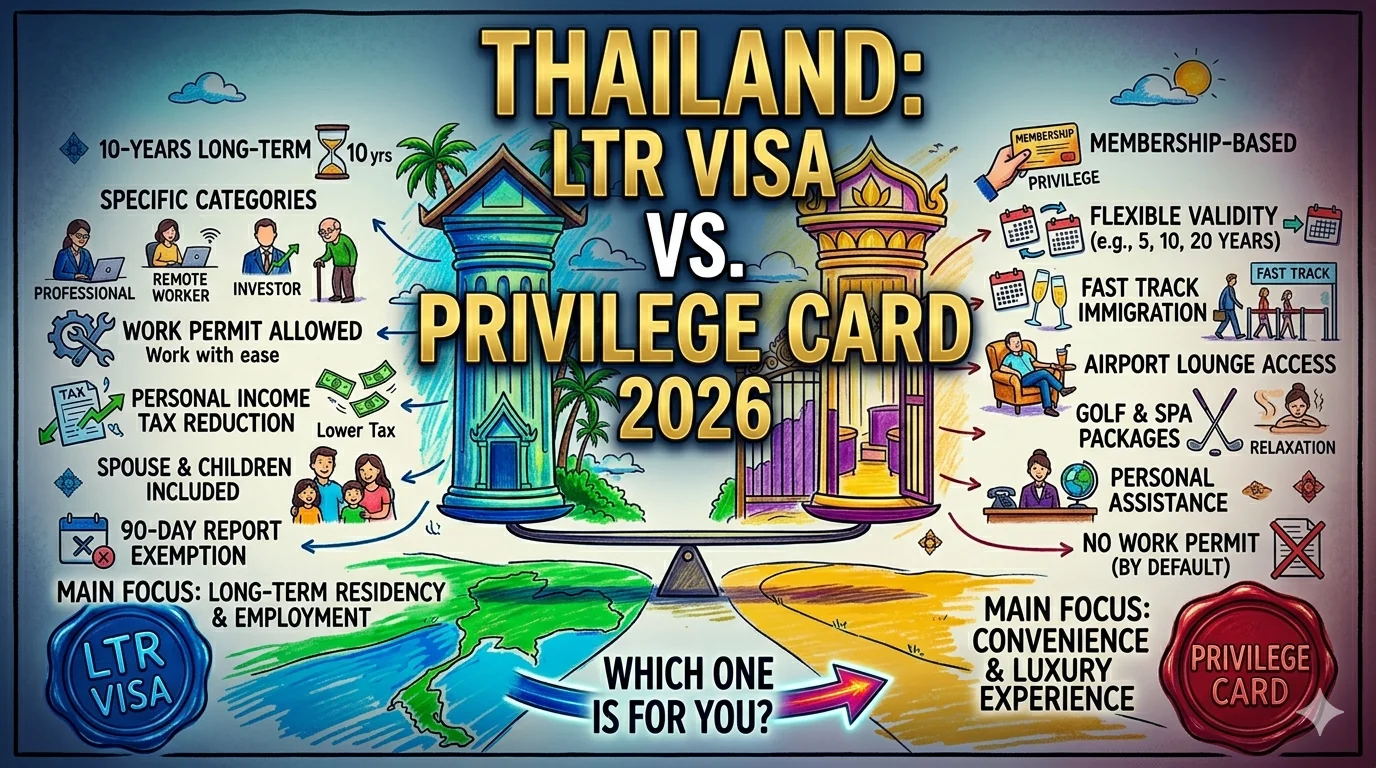
For how the LTR compares to the Thailand Privilege Card for long-stay options: Thailand LTR Visa vs Privilege Card 2026.
Immigration rules change. Always verify current requirements against the official BOI portal before submitting your application: ltr.boi.go.th
Where to Go from Here
For the full LTR application process once you have confirmed eligibility: How to Apply for the Thailand LTR Visa 2026.
For all four LTR categories side by side: Thailand LTR Visa Categories 2026.
For the full LTR Visa destination overview: Thailand LTR Visa 2026.