The Thailand Long-Term Resident (LTR) visa gives qualifying foreigners a 10-year visa, work-from-Thailand authorisation, and a flat 17% personal income tax rate. It costs approximately 50,000 baht in government fees. The income and asset thresholds are the main barrier for most applicants.
What is the LTR visa?
The Thailand Long-Term Resident (LTR) visa was launched by the Thai government in 2022 to attract high-value foreign residents. It gives you a 10-year visa with annual permission-to-stay stamps, exemption from 90-day reporting, work-from-Thailand authorisation for qualifying categories, and a flat 17% personal income tax rate instead of Thailand's standard progressive rates that reach 35%. For people who qualify, it is one of the most generous long-stay visa programmes in Southeast Asia.
The visa is administered by the Thailand Board of Investment (BOI), not by standard Thai immigration. Applications go through the BOI, with a processing time of 20 to 30 business days. The government application fee is approximately 50,000 baht, making it far cheaper than the Thailand Privilege Card. The eligibility thresholds are strict and exclude most applicants.
The four LTR categories at a glance
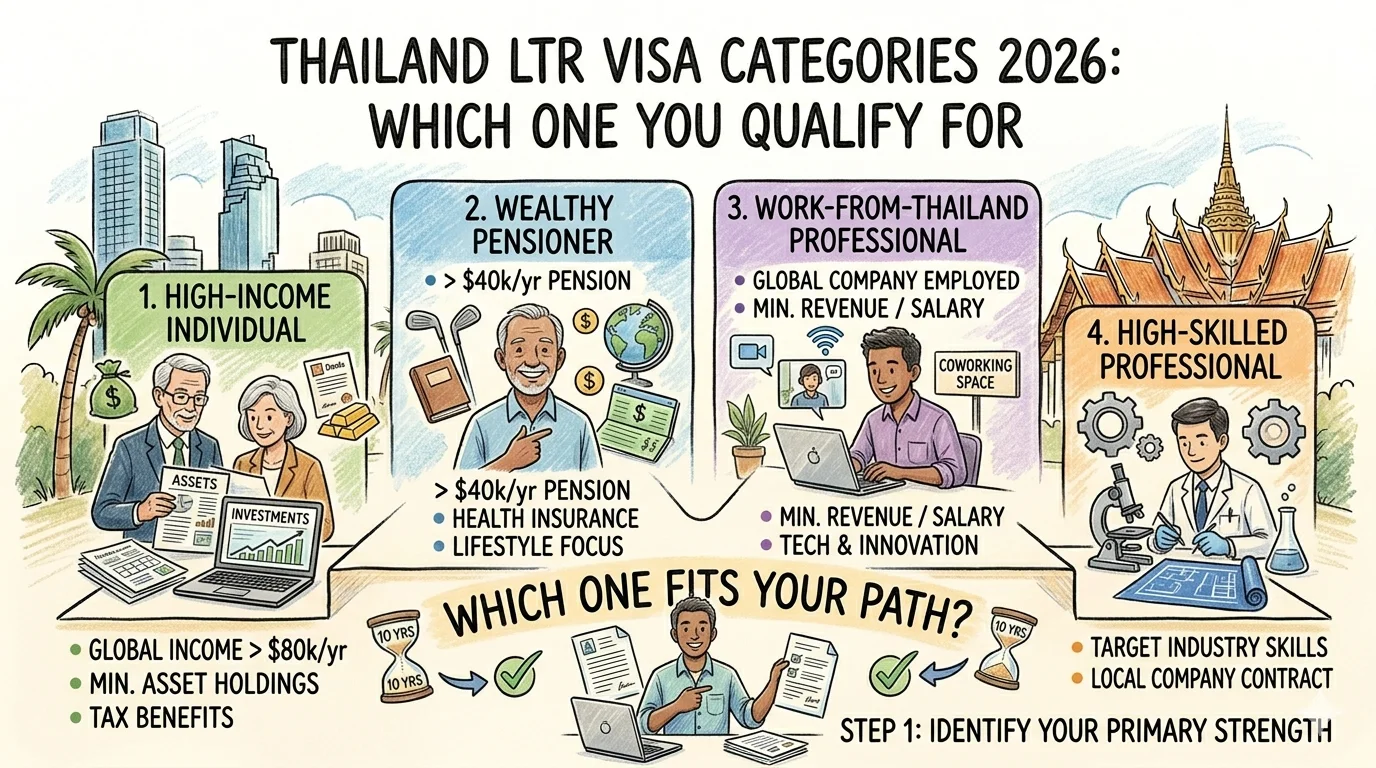
Category | Who it's for | Income requirement | Asset requirement |
|---|---|---|---|
💰 Wealthy Global Citizen | High-net-worth individuals | USD 80,000/yr from investments | USD 1,000,000 in assets |
🏖️ Wealthy Pensioner | Retirees with pension income | USD 40,000/yr pension | None |
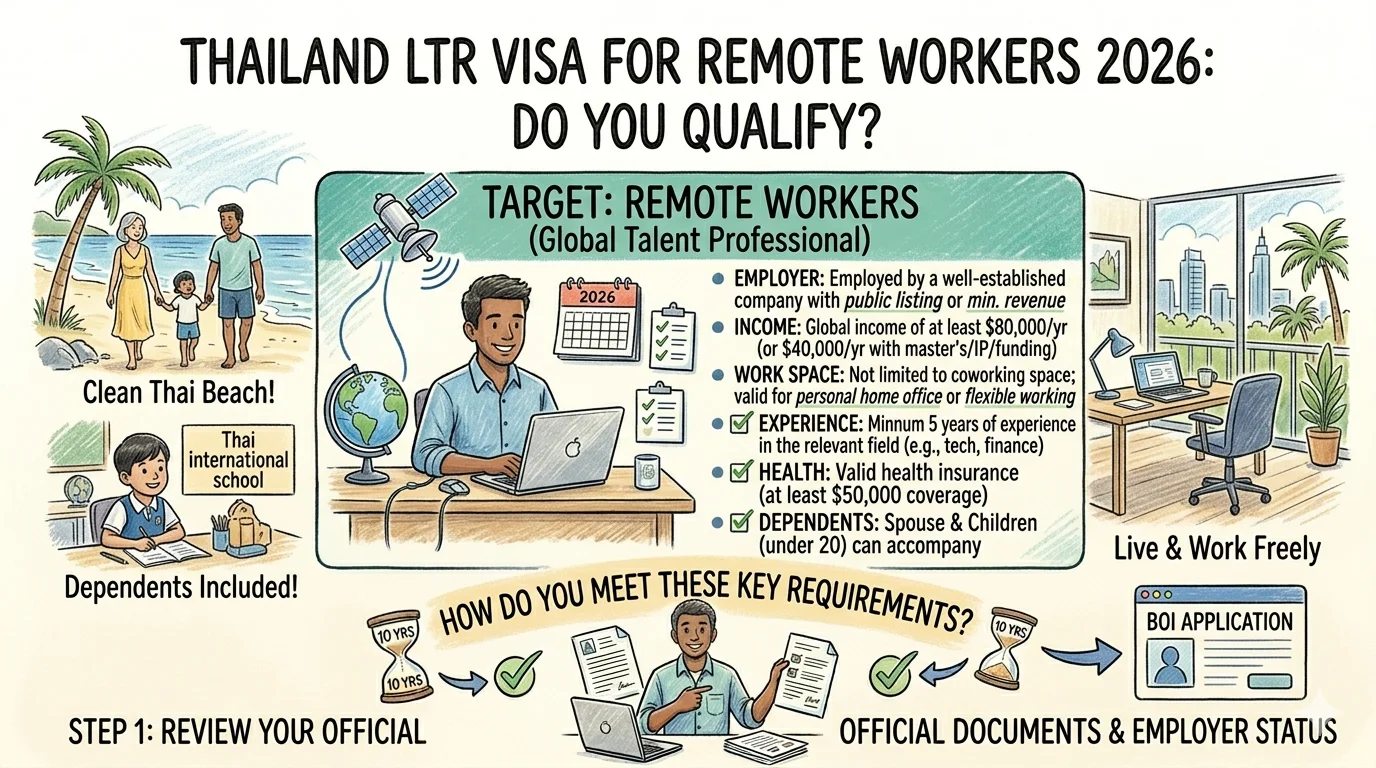
💻 Work-from-Thailand Professional | Remote workers for foreign employers | USD 80,000/yr employment income | None |
🔬 Highly Skilled Professional | Specialists in BOI target sectors | Set by sector | None |
All categories require a health insurance policy with at least USD 50,000 in coverage. See the full category breakdown for exact thresholds and documentation requirements.
Tax benefits
The 17% flat income tax rate applies to Thai-sourced employment income for Work-from-Thailand and Highly Skilled categories. Standard Thai progressive income tax runs from 5% to 35%, so the savings for higher earners are substantial. Wealthy Global Citizens and Wealthy Pensioners also receive favourable treatment on foreign income brought into Thailand.
The LTR tax benefits are the strongest financial case for pursuing this visa over the Privilege Card or retirement visa. Read the full tax benefits guide before making a decision.
Work rights
The Work-from-Thailand LTR category explicitly authorises working remotely for a foreign employer without a Thai work permit. This is the only standard Thai visa category that provides this formal authorisation. All other long-stay visas, including the Privilege Card and the retirement visa, do not authorise remote work.
The Highly Skilled category allows employment within Thailand at Thai organisations in qualifying sectors. This requires a work permit issued alongside the LTR visa. The BOI coordinates this so the visa and work permit are handled together rather than through two separate bureaucracies.
Application process: step by step
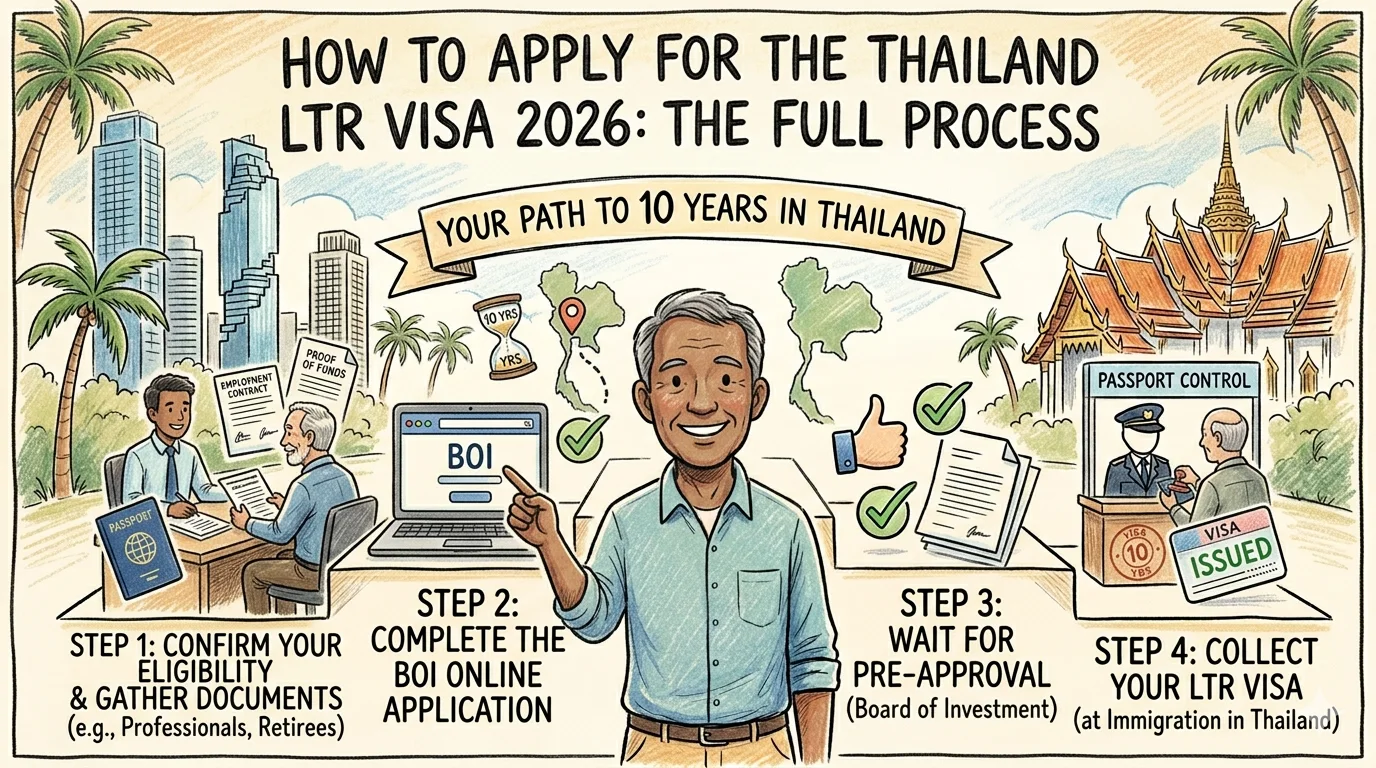
Step | What happens |
|---|---|
1. Check eligibility | Confirm your category and gather financial documentation |
2. Submit via BOI portal | Upload documents, health insurance certificate, and category-specific supporting evidence |
3. BOI review | Processing takes 20 to 30 business days |
4. Receive approval letter | BOI issues a letter of approval on successful review |
5. Stamp the visa | Stamped at a Thai embassy abroad or Thai immigration if already in Thailand |
6. Active visa | Total time from application to active visa is typically 4 to 8 weeks |
See the step-by-step application guide for the full document checklist by category.
Health insurance requirement
All LTR categories require a health insurance policy with at least USD 50,000 (approximately 1,750,000 baht) in coverage. This is significantly higher than the retirement visa minimum of 400,000 baht. Most comprehensive expat health insurance plans from international providers like Cigna, AXA, or BUPA meet this threshold.
The insurance must remain active throughout your LTR term. Factor the annual premium (typically 40,000 to 100,000 baht for a comprehensive international plan) into your total cost comparison with the Privilege Card.
LTR vs Privilege Card vs Retirement Visa
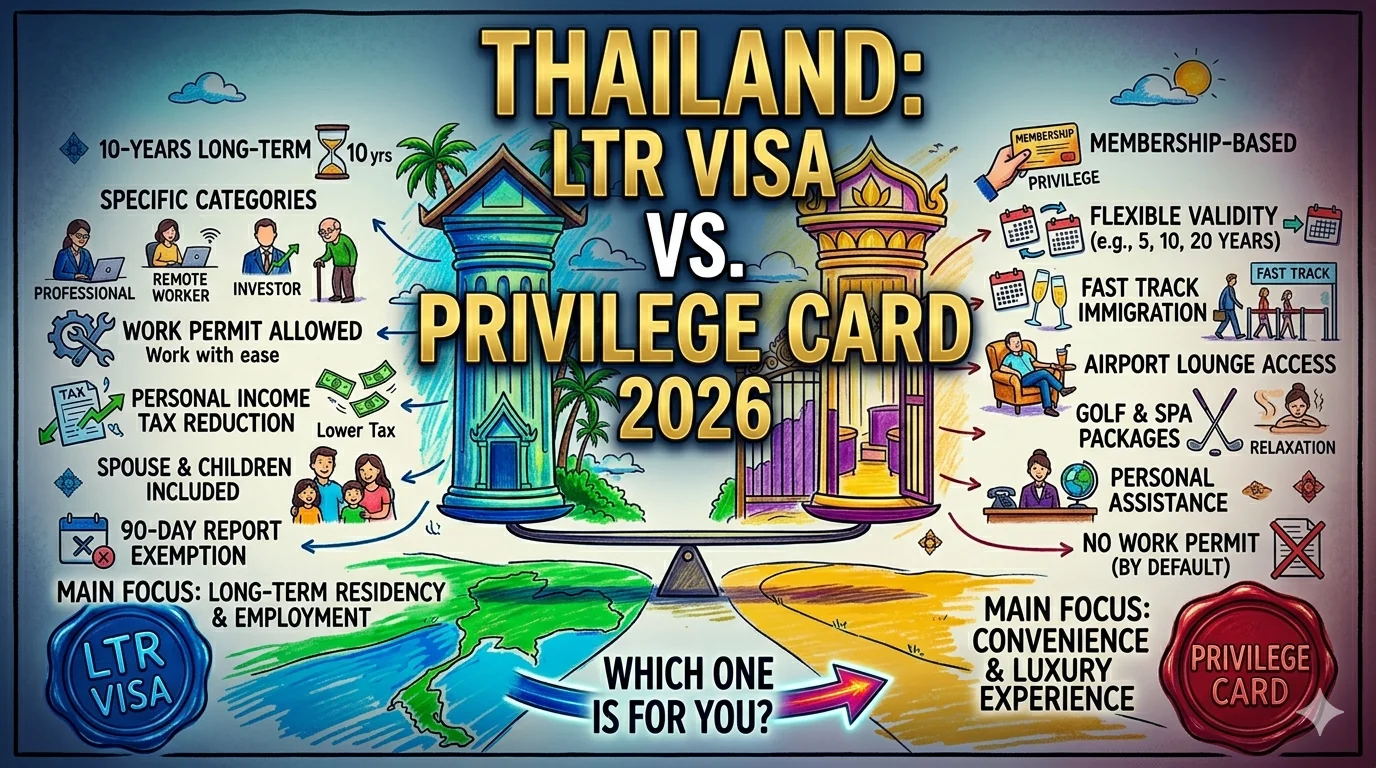
LTR Visa | Privilege Card | Retirement Visa | |
|---|---|---|---|
Cost | ~50,000 baht | 600,000 to 2,500,000 baht | ~10,000 baht/yr |
Duration | 10 years | 5 to 20 years | 1 year (renewable) |
90-day reporting | Exempt | Exempt | Required |
Remote work authorised | ✅ Yes (WFT category) | ❌ No | ❌ No |
Flat tax rate | ✅ 17% | ❌ No | ❌ No |
Age requirement | None | None | 50+ |
Income threshold | High | None | Moderate |
For anyone who qualifies, the LTR is almost always the right choice. The 50,000 baht fee is a fraction of the Privilege Card cost, and the tax benefits can save hundreds of thousands of baht per year. See the LTR vs Privilege Card comparison for a full breakdown.
Who should not apply for the LTR
The LTR is not suitable for freelancers, self-employed professionals, or remote workers earning under USD 80,000 per year. It is not suitable for pensioners earning under USD 40,000 per year. If your income is below these thresholds or cannot be documented in the required format, the application will be rejected.
The Privilege Card and DTV are the practical alternatives for this group. See the remote worker eligibility guide for specific employer and income requirements.
Where to go from here
The LTR is one piece of a longer-term decision about how to structure your life in Thailand legally and financially. These guides cover the decisions that come next.
For a side-by-side comparison of every long-stay option: the Thailand Visa Guide covers the LTR, DTV, Privilege Card, and retirement visa in one place.
For the tax picture: the LTR tax benefits guide breaks down exactly what the 17% rate means for different income levels and how foreign income is treated.
For the Privilege Card as an alternative: the LTR vs Privilege Card comparison covers cost, flexibility, and who each option actually suits.
For property once you are settled: the foreigners buying property in Thailand guide covers condo ownership, leasehold, and what the LTR status means for your purchase options.